A Conversation with Alex Ertel on Her Project, “Women of the American West”
By: Alex Ertel and Britt Henslee
“Women of the American West” is a digital public history project created by Alex Ertel. Because a finished website cannot fully show the research process and interpretive choices behind it, what follows is an interview conducted by Britt Henslee that gives readers insight into the work beneath the surface. You can access Ertel’s project website here: “Women of the American West” by Alex Ertel
When you started “Women of the American West,” what was your guiding research question or curiosity, and how did it change as you began working with sources and building the site?
When I started the project, I really wanted to foreground an idea of the West that is often underrepresented or forgotten from the dominant historical narrative. I had just finished reading Sarah Winnemucca’s autobiography, which gave me a starting point for my research in terms of considering the narrative often forced upon Indigenous women in popular history. The guiding question became: What voices were removed and why? Of course, that is a huge (and general) question in the scheme of historical scholarship, and one that was not answered entirely within my project. But it led me to finding three women—in addition to Winnemucca—that would become the focus of my research.
While discussing the project with my professor, Dr. Cameron Blevins, he introduced Dr. Justina Ford as a subject for research. Ford’s connections to Colorado made her story seem particularly significant for me—and that local interest led me to Clara Brown. I decided to focus on Tye Leung Schulze due to her voting rights activism and her distinction as the first Chinese American woman to cast a ballot in a federal election.
When considering women of the West, white women are often given the focus while agency is stripped from Women of Color. Each woman I selected did something profound within her lifetime, despite the systematic and violent barriers brought against them. These four women were not the only ones to do so, and I had a list of more women—but time is a constraint we are all too familiar with. I ended up limiting the project to only four women in order to research each woman adequately and frame the second part of my guiding question: Why were their voices removed?
What did your research methodology look like? How did you find, select, and evaluate sources for a digital project? What criteria did you use to decide what made it onto the website? What were the most unexpected challenges you ran into—technical, archival, interpretive, or ethical—and how did you adapt your approach in response?
I relied heavily on local histories, Sarah Winnemucca’s autobiography, and primary sources such as newspaper articles for the initial research. For a digital project, having strong visual elements was paramount. I wanted to be sure the webpages did not feel crowded with text—a significant change from a traditional paper. I had to decide what information was crucial to keep on the webpage in order to maintain both a simple and informative design. I wanted to each page to be cohesive in providing a general background of each woman, their achievements, and the social systems against them. It was crucial that each woman was the focus of her own page, and I wanted to show each one of their faces.
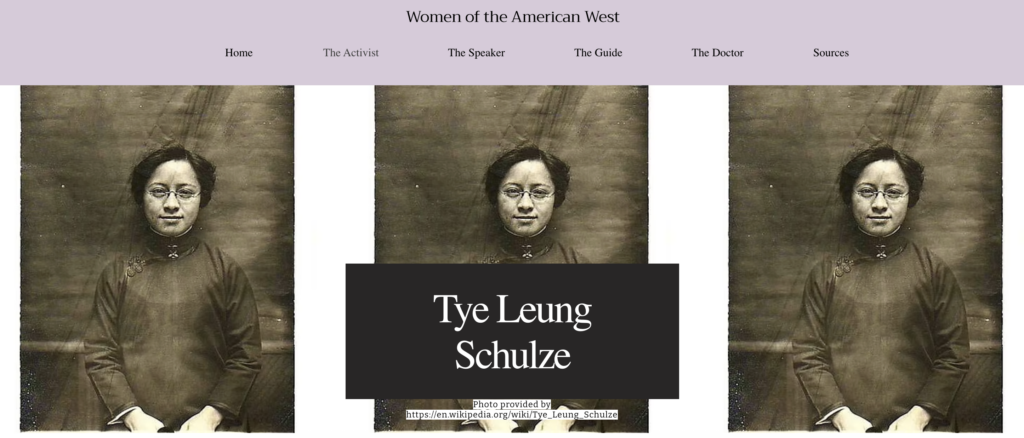
Above: image of Alex Ertel’s website page for Tye Leung Schulze showing how she formatted each woman’s individual pages while centering their names and faces. Tye Leung Schulze’s page can be found under “The Activist” on Ertel’s website, linked here: The Activist – Tye Leung Schulze .
One ethical challenge that arose was with how to include primary sources that depicted the poor treatment of People of Color on my website, such as racist political cartoons, laws, or statements made by soldiers. I did not want to give these images or sources the center focus or power, but it was important to have them present since they provide an uncomfortable answer to the question “Why were these voices removed from history?” Using hyperlinks to the primary sources allowed me to give the option for more information if the viewer chose, without having to explicitly provide all of the details. I did redact the use of slurs that were present in the quotes I used on the website.
Were there moments where layout, navigation, or visual choices pushed you toward a different argument than you might have made in a traditional paper?
The current version of the website is not its first design. In my initial drafts, there were many more images of white men and their mythic proportions in an attempt to draw attention to dominant historical narratives of the American West. However, after some feedback, it was clear that the design did not do what I intended—which was to contrast concepts of New Western History with the public memory of the American West.
In a paper, I would have been able to include this contrast in a designated section, possibly near the conclusion to emphasize my claim. On a website, however, the visuals need to speak loudly and quickly. Website viewers don’t visit a page to read a 20-page essay where the conclusion ties everything together. Including so many images of the contrasting viewpoint in the original version of my website could have led viewers to believe I myself was staking that claim. My intervention needed to be clearer and more readily available.
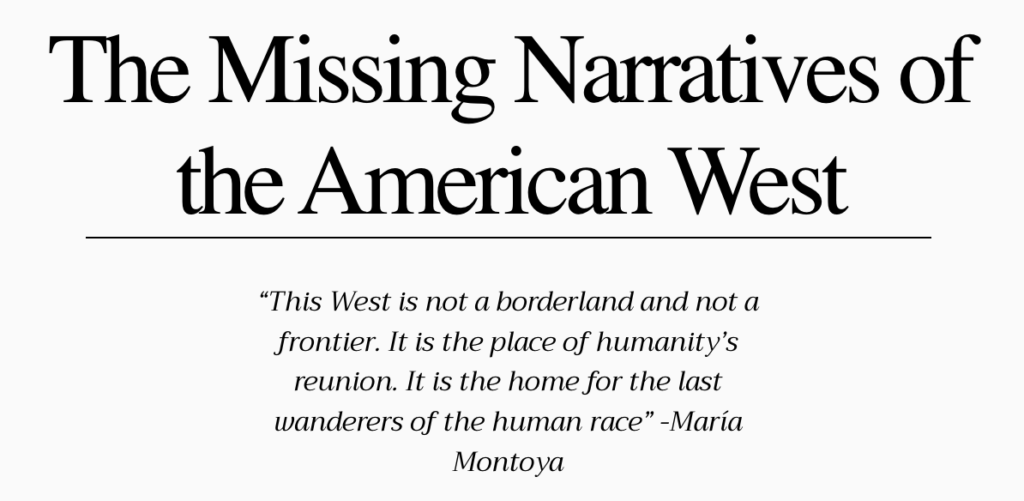
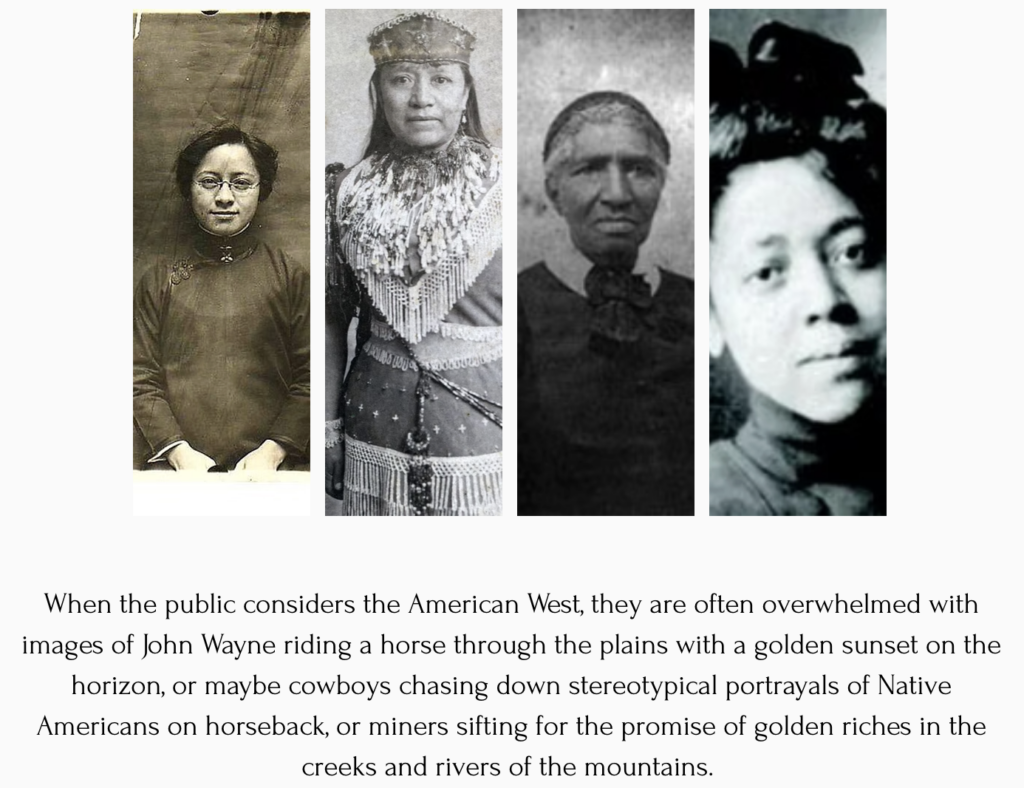
Above: images of Ertel’s website homepage centering the women missing from the dominant narrative while staking her claim loudly and quickly in the website’s introduction. Linked here: Homepage, “Women of the American West” .
Compared to a traditional paper, what do you think a website limits you from doing, and what does it enable that a paper typically cannot?
A website, compared to a paper, is more limiting in terms of word count. As with any visual presentation, you want it to be concise, which sometimes means leaving out portions a paper would provide the space for.
However, a website gives a lot more freedom to play with images and provide links for people who want to learn more. I appreciated that I could use so many images and the interactiveness of linking information throughout the website rather than only in the final pages of an essay. One example of this would be the hyperlinks to short documentaries that explored topics like Denver’s Hop Alley and the L.A. Chinese Massacre when discussing the treatment of Chinese people in the West.
Websites also provide different benefits to their audience than traditional papers, letting them explore more at their own pace—particularly with heavy topics. It allows for more processing time.
If you were to revise or expand the site in the future, what would you change or add and why?
I would start by bringing in more women on my original list from back when I began researching for this project. I would have liked to add an additional page on media as a whole, visually representing the imagined white, masculine version of the American West. This was something I removed from the final project since it turned the focus too much back to familiar history, but I would be interested in finding a way to incorporate and contrast the dominant narrative without centering it. I would also have liked to explore more about LGBTQIA+ history during this period and would do that with more time.
